
INTRODUCTION:
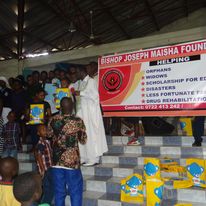
Bishop Maisha Foundation is a nonprofit making organization situated at Baptist Church Majengo Mpya Likoni Mombasa County in the Republic of Kenya. It is registered under the section 10 of the societies Act reference number R. 49360. The organization‘s objectives are to provide care and protection, rehabilitate, educate, provide primary health care and to reintegrate the orphans and vulnerable children in the community. It began in 2017 by Joseph Maisha who is the founder of Ushindi Baptist church. The Overseer shared the vision of starting the Foundation with a few other likeminded brethren who had a similar burden. The brethren met on May 2nd, 2017 resolved to start the foundation. It has grown from a home of 20 children to an institution catering for an average of 300 children who are managed in Bishop Maisha foundation
EXECUTIVE SUMMARY
The foundation takes care of the abandoned, orphaned, the neglected and whose rights have been violated.
Children living in post-crisis situations – this includes children in conflict zones, in refugee camps, children who have been displaced following the destruction of their physical environment. Children that work – poor children may have to work to help support their families and themselves. Children who live in urban slums and those Children from households that can’t afford to provide their basic needs. Ethnic minorities and indigenous peoples. Children in rural, remote, nomadic or migrant communities – these children often lack physical access to education. Physically challenged children –there is often a lack of suitable resources and facilities; teachers are trained to deal with the special needs of these children; when the necessary physical, emotional or intellectual support is not provided, these children are kept out of the education system.
All these children of 5 years and above are brought to the foundation for care and protection. Upon intake an individual placement plan is made. This is based on the background information. With time an alternative care is sought; this involves extensive case works, field visits, home visits, follow ups and enough areas of networking. For those children whose guardians are found and assessed the children are given back under probation care. Currently Bishop Maisha is taking care and protecting 300 children in different homes
Over the years Bishop Maisha foundation has steadily grown both in size and quality moving from an individual initiative to an organization-based structure. It presently caters for 300 children including babies from one day old to 18 years (abandoned, orphaned and vulnerable children and those neglected. Bishop Maisha foundation strives to help these children understand that being orphaned or vulnerable is not their identity by offering a Godly home, a loving and a family environment. We also identify, develop each child’s unique and special talents, teach, transform and train the children through education and mentorship. We believe that every child deserves the best start in life and a chance to fulfill their potential we therefore support them, stand up for them and bring out the best in each and every child.
Mission
Bishop Maisha Foundation shall endeavor to improve the situation of orphaned and vulnerable children by providing care and protection, guide the reintegration process into society and address the factors leading to their situation.
Vision
A society in which all children will be able to live a dignified existence with equal and just access to future opportunities in life.
Objectives
- To provide parental care and guidance to the children
- Rehabilitation and reintegration of children back to the community
- To provide primary health care to the children
- To provide quality education to the children
- To train care givers in care giving skills to enable these children get adequate care, love and support
Core values
- Integrity
- Honesty
- Commitment
- Motivated
- Efficient
a) Physical needs
The basic needs of food, health care, shelter and clothing, should be dealt with first. Health issues such as malnutrition, sanitation, illness and, the lack of proper healthcare, hamper education. Poor children are often malnourished, either because they simply do not get enough food, or because their diet is not varied enough to provide all the essential nutrients. Hungry, malnourished children cannot concentrate, and are more prone to different diseases. Malaria, which is particularly prevalent in Africa, contributes to reduced school attendance, and ultimately poor achievement. The poorest children may also lack appropriate shelter and clothing. They may be homeless, or there may be no space, or time, at home for homework.
b) School attendance needs
School attendance needs include school fees, books, uniforms and transportation. It is important to note that even when school fees are in session, there are other related costs such as those for books, uniforms, transportation and lunch, which poor children cannot afford.
c) Cognitive needs
Lacking cognitive stimulation in the early years, poor children often lag behind their peers in academic achievement, and particularly with regard to language development. The language of the school is likely to be different from that of the mother tongue, which only serves to compound the problem. Most children learn more by being actively involved in the teaching and learning processes. But this is particularly important for the poorest children, who must grapple with a variety of new experiences and concepts in school.
Education programs that are intended to create equal opportunities for all children must draw on the life experiences of all children. From the lifestyle of children with different backgrounds. The poorest child might not have a television at home, but she, or he, is likely to be familiar with traditional stories. She, or he, may not have piped water where she, or he, lives but she or he would know the difference between “clean and dirty water.” Remedial work and the achievement of competences in all areas of the curriculum, must be an integral part of the education process.
d) Social and emotional needs
The poorest children need to build their confidence, to feel that they can achieve in school, and in the wider world. If they do not believe they can do well at school, they might not try. They need to learn:
- How to develop and maintain social relationships and how to manage conflicts and differences. Some of these children have grown up in an environment where aggression is necessary for survival.
- How to channel this aggression into appropriate activities like music or sports.
- Positive attitudes and values fostered in a caring and secure learning environment. With the increasing incidence of social problems and civil unrest, it has become imperative that children learn positive values and attitudes, such as cooperation, responsibility, pride in a job well done, and love of success. The poorest children often do not receive the kind of emotional support they need from their homes. In many cases, there is too little parental (or other adult) support and guidance. Hence, the education system should take greater responsibility for their upbringing, if they are to learn how to function well in society.
MANAGEMENT
The management comprises of the Director, and administrators. While they coordinate activities in the foundation, they also meet among themselves regularly, under the coordination of the Director. Their collective responsibilities, which in turn lay ultimately with the Director, are:
- To ensure that plans as laid out and agreed upon are implemented timely, efficiently and effectively.
- to coordinate the translation of plans into more detailed action plans
- To liaise with government and other NGO’s and CBO’s where it concerns the interests of Bishop Maisha Foundation, directly or indirectly.
- To report on progress of the activities and finances, at regular and agreed-upon intervals, to the Board and other interested parties such as donors.
- To be answerable to the board and other parties for any enquiries.
BOARD OF DIRECTORS
The board comprises of a chairperson, Secretary and Treasurer as well as a number of members making a total of not less than five persons. The board members advocate with the relevant persons or Organizations on behalf of the foundation. Dialogue between Board and daily Management is quite satisfactory.
LICENCES UNDER WHICH BISHOP MAISHA FOUNDATION OPERATES:
Bishop Maisha Foundation is registered under the Ministry of Gender, Children and Social Development as a Charitable Children’s Institution under Regulation 3(1) of the Children (Charitable children’s institution) Regulations, 2005 for a period of three years.
It also has a PIN Certificate from the Kenya Revenue Authority.
NAME OF THE AUDITORS
1. Echesa auditors’ company ltd
All auditors are commissioned by one of the donor Organization i.e.but they do audit for the whole Organization.
STATEMENT OF NEEDS
As Ushindi Global Foundation, we have identified attached list of children from various groups highlighted above whom we seek to sponsor through their education because we believe that when you educate one soul, the entire village will be transformed. We intend to be part of their lives since they are still juniors and assist them socially, mentally, emotionally and financially to ensure that they become responsible adults and change agents in their communities.
In connection with our vision “A society in which all children will be able to live a dignified existence, with equal and just access to opportunities in life” we not only focus on the basic needs, that is food, clothing and shelter but also adhere to the rights of a child as written under the Children act Cap 586 Laws of Kenya.
FUNDINGS
Bishop Maisha Foundation attains its funding from well-wishers and friends.